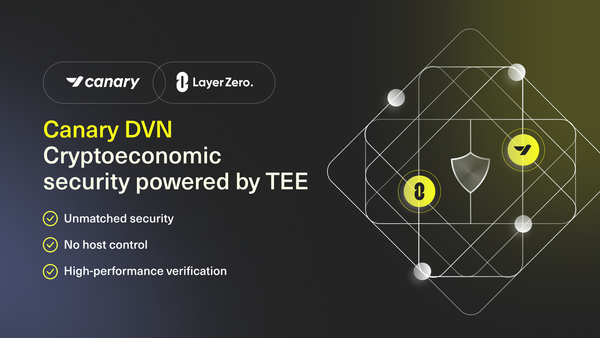
From Keys to Proofs: Introducing Cipher

Starting September 7, 2026, Canary will introduce a $1 onchain verification fee per message as it brings Cipher to the Canary DVN.
For the past two years, Canary has had one mission: build the most secure verification infrastructure in crypto.
That mission matters now more than ever. Interoperability has become one of crypto’s highest-value attack surfaces, with billions lost through bridge and messaging exploits. Too often, security has depended on a single verification path, a single signer, or a single “yes.”
Canary was built to reject that model.
Today, Canary has signed nearly a million messages, verified more than $30 billion in cross-chain transaction volume, and is used by over 360 applications. Throughout that time, Canary has maintained 100% uptime with zero security incidents.
That track record was not achieved by following the standard approach. Canary is a fully independent verification client. Every message is checked inside Trusted Execution Environments, with K-of-N quorum logic across independent RPC providers, confirmation thresholds, and chain state before anything is signed.
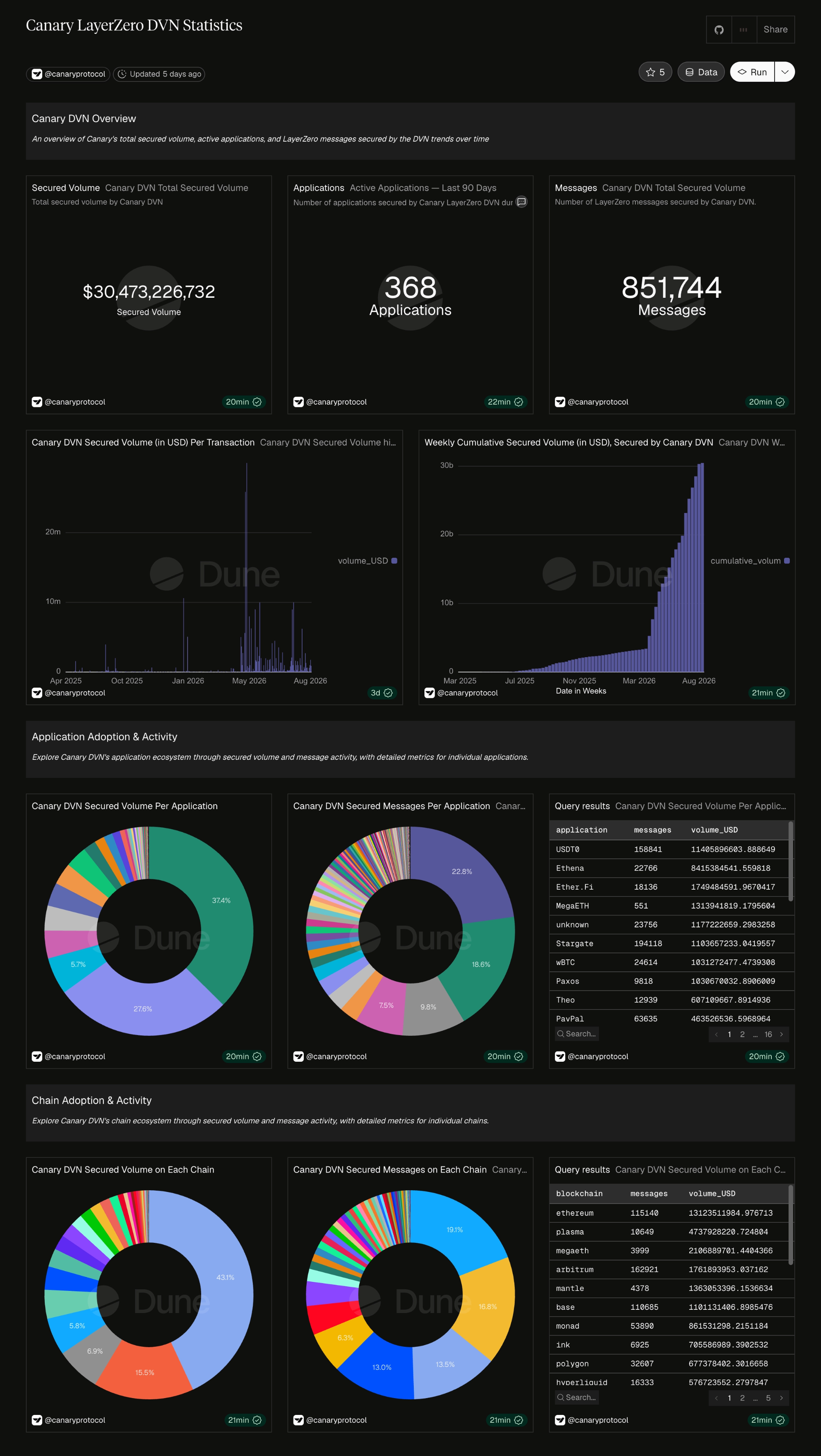
Live metrics: dune.com/canaryprotocol/canary-layerzero-dvn-statistics. Dune indexes a subset of the chains Canary supports; totals across all supported chains are higher.
Now Canary is going further.
Cipher Comes to Canary DVN
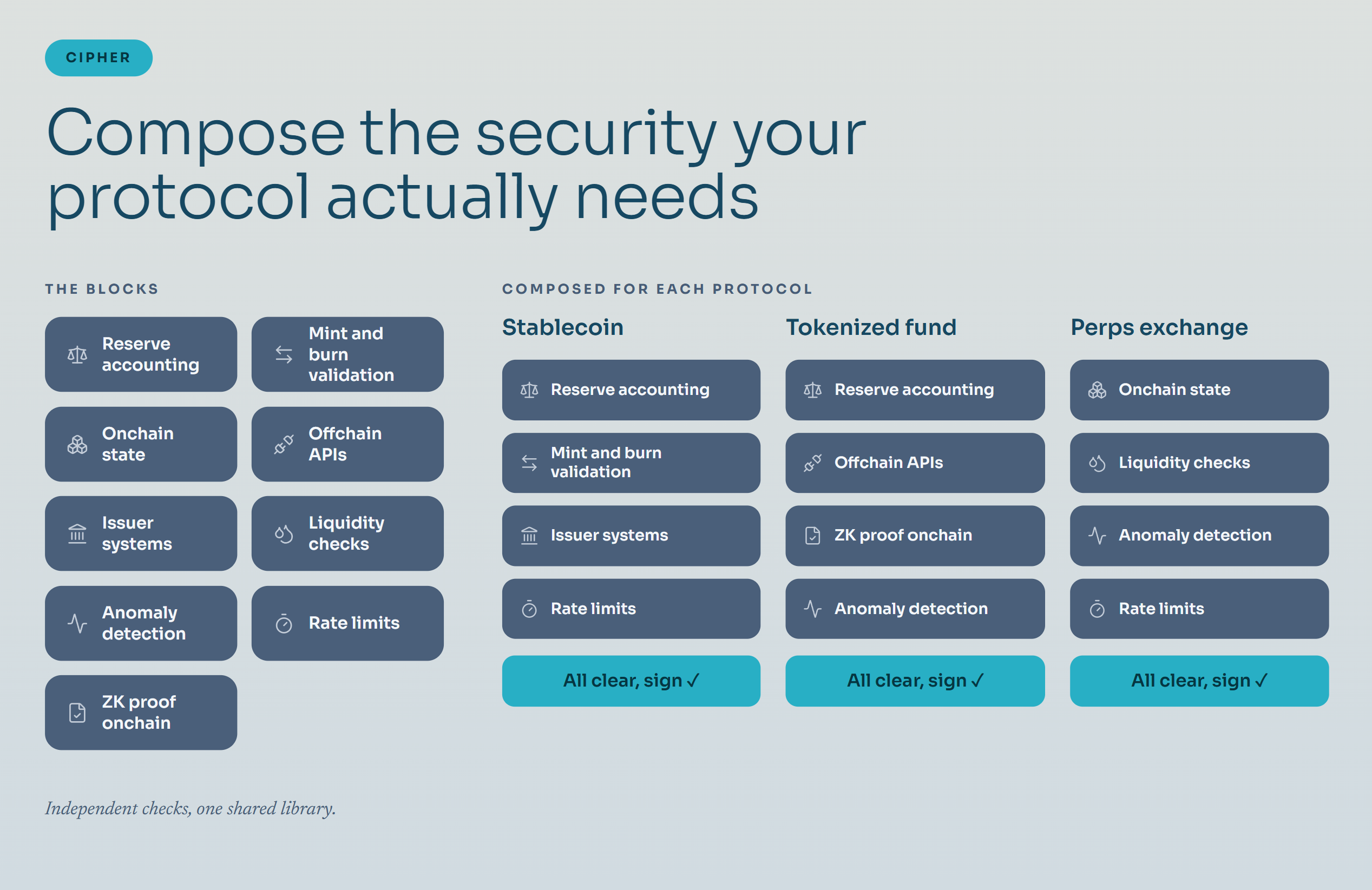
Cipher is Canary’s composable security framework: a set of security building blocks that can be tailored to each protocol, asset, chain, backend system, and risk profile.
Because cross-chain security cannot be one-size-fits-all.
A stablecoin, a tokenised fund, a lending protocol, and a perps exchange may all use cross-chain messaging, but they do not share the same risks. They have different accounting systems, backend infrastructure, liquidity assumptions, token logic, issuer controls, and settlement requirements.
So their security should not be identical.
Cipher allows protocols to compose the checks they actually need before a transfer is released:
- Reserve accounting and collateralisation: enforce that supply is genuinely backed
- Mint-and-burn validation: no mint without its corresponding burn
- Onchain state and offchain APIs: verification is not limited to what lives on a chain
- Issuer systems, TradFi systems, and crypto-native infrastructure: brought into the verification path
- Liquidity checks, anomaly detection, and rate limits
- High-value transfer policies: deeper verification where more is at stake
- Zero-knowledge proofs verified onchain
It also allows protocols to add custom verification hooks to the Canary DVN. For high-value, anomalous, or suspicious transfers, Canary can ping issuer infrastructure, protocol backends, risk engines, compliance systems, or any other required source of truth before signing.
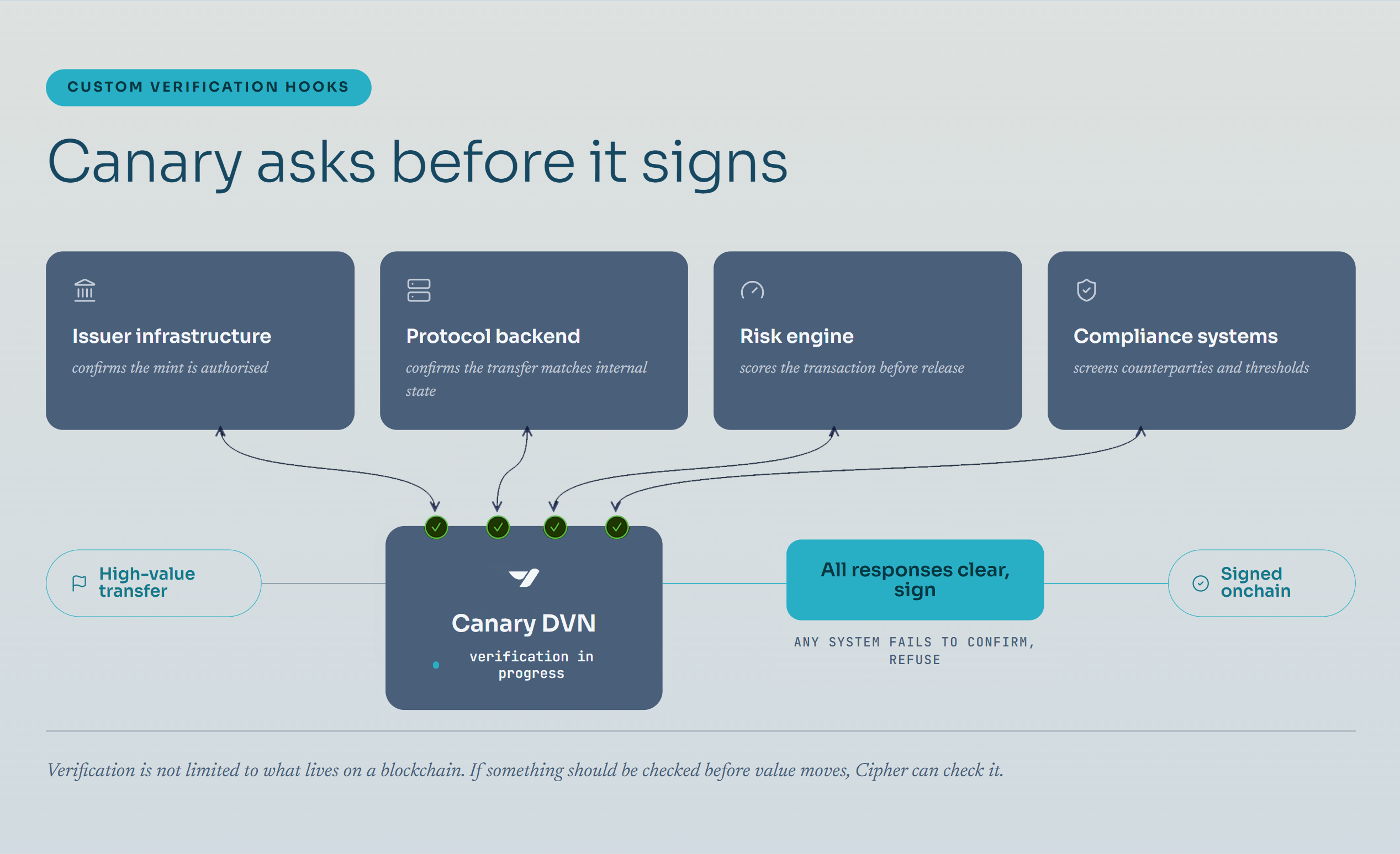
If something should be verified before value moves, Cipher is designed to verify it.
Not after the transfer.
Not after a report.
Before release.
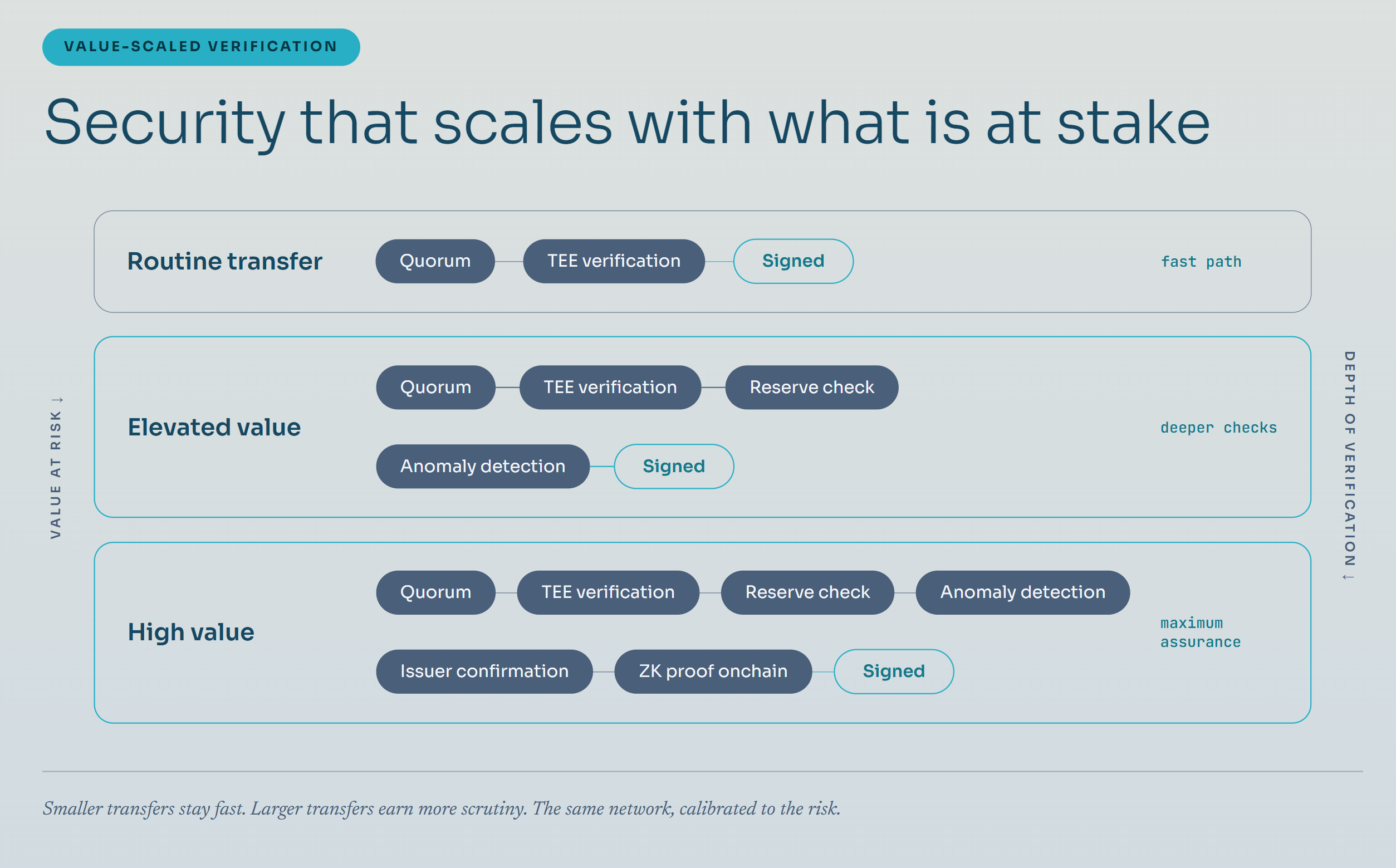
This is security that scales with what is at stake. Smaller transfers stay fast. Larger or riskier transfers trigger deeper verification across more systems, more infrastructure, and more proof layers.
Cipher is already in production with select protocols, including live reserve accounting. Capabilities are rolling out progressively across the Canary DVN, shipped as they are ready rather than to a fixed date.
Always an “And,” Never an “Or”
Underneath Cipher, Canary is expanding toward multi-cloud, multi-region, multi-hardware infrastructure with independent TEE technologies and onchain zero-knowledge verification. No single cloud provider, region, hardware vulnerability, RPC path, backend system, or signer should be enough to compromise the network.
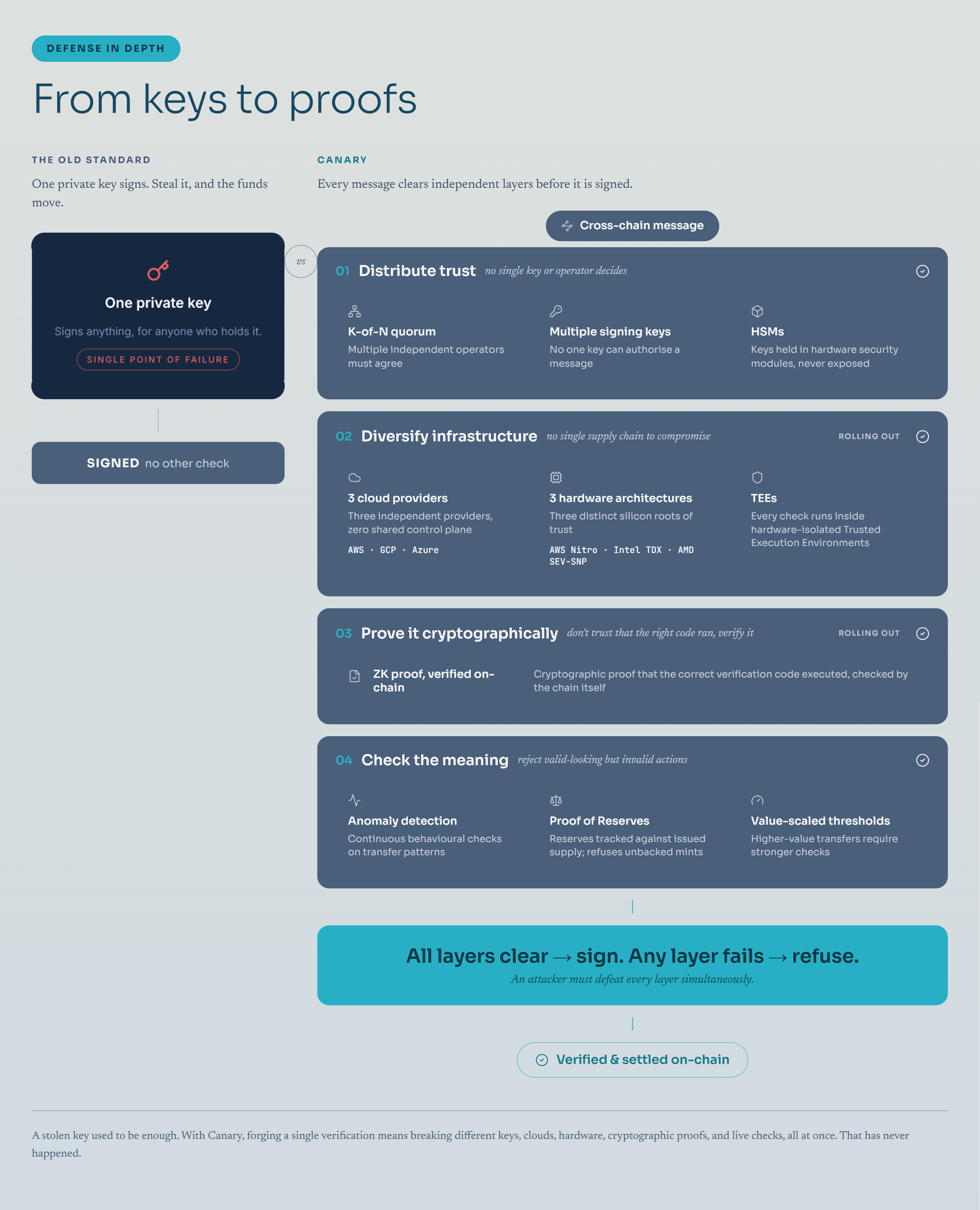
It is always an “and,” never an “or.”
Multiple RPCs. Multiple checks. Multiple systems. Multiple layers of verification.
That is the Canary standard.
What’s Changing
From September 7, 2026, Canary will introduce a $1 verification fee per message.
From day one, every application on Canary gets what two years of operation have already proven: fully independent verification inside Trusted Execution Environments, K-of-N quorum across independent RPC providers, 100% uptime, zero security incidents, and the Cipher capabilities live today.
The fee funds what comes next: broader Cipher rollout, custom verification hooks, multi-cloud and multi-hardware resilience, multiple independent TEE technologies, onchain ZK verification, continuous audits, and the next generation of application-specific security.
For applications, the experience remains unchanged:
- No integration changes
- No billing setup
- No invoices
- No service interruption
- Fee collected onchain as part of the standard message cost
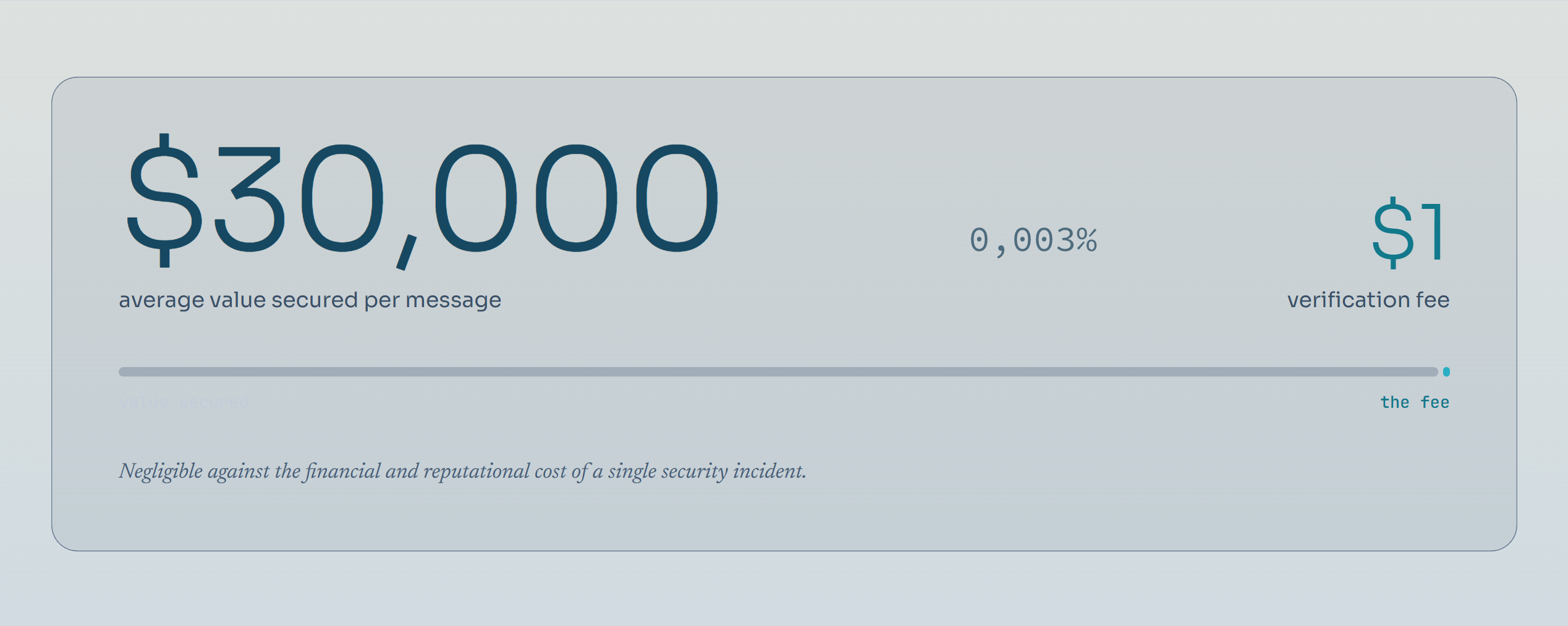
Based on current network activity, the average Canary message represents approximately $30,000 in transaction value. A $1 fee is roughly 0.003% of the value being verified, negligible compared with the financial and reputational cost of a single security incident.
Higher-volume teams, or protocols that need advanced Cipher capabilities, can work directly with Canary on tailored commercial agreements.
FAQ
Does this require integration changes?
No. Existing integrations continue working exactly as before. The fee is collected onchain as part of the standard message cost.
Can protocols add their own checks?
Yes. Cipher supports custom verification hooks, allowing protocol infrastructure, issuer APIs, risk systems, compliance systems, or backend services to participate in verification before Canary signs.
Is Cipher mandatory?
No. Cipher is composable by design. Protocols configure the checks that match their own risk profile. Every application continues to receive Canary’s core verification standard.
When will Cipher capabilities be available?
Cipher is already in production with select protocols. Capabilities roll out progressively across the Canary DVN as they are ready. Protocols that want early access to advanced capabilities can talk to us directly.
How is Canary different from other DVNs?
Canary is a custom-built, fully independent verifier, not a shared reference implementation. It has operated for ~two years with 100% uptime and zero security incidents, verifying more than $30 billion in cross-chain volume across hundreds of applications. Every application configures its own DVN setup; our view is simply that lighter verification carries tradeoffs in reliability and security that only become visible when something goes wrong.
What does the fee fund?
Engineering, audits, multi-cloud and multi-hardware infrastructure, independent TEE technologies, onchain zero-knowledge verification, and continued Cipher development.
From Keys to Proofs
Nearly every major cross-chain exploit has the same shape. Someone held a key. Something signed. Value moved.
The industry’s answer has been to guard the key more carefully. Ours is to make the key insufficient.
That is what Cipher is for. Not one signer, but many. Not one check, but every check a protocol actually needs. Not trusting that the right code ran, but proving it onchain, where anyone can verify it.
For two years, Canary has operated at scale without a single incident. That was the proof of concept. What comes next is the proof itself.
Trillions of dollars are moving onchain. They will not be secured by a private key and good intentions.
The old standard said yes. Canary says no.
This September, the standard goes Cipher